
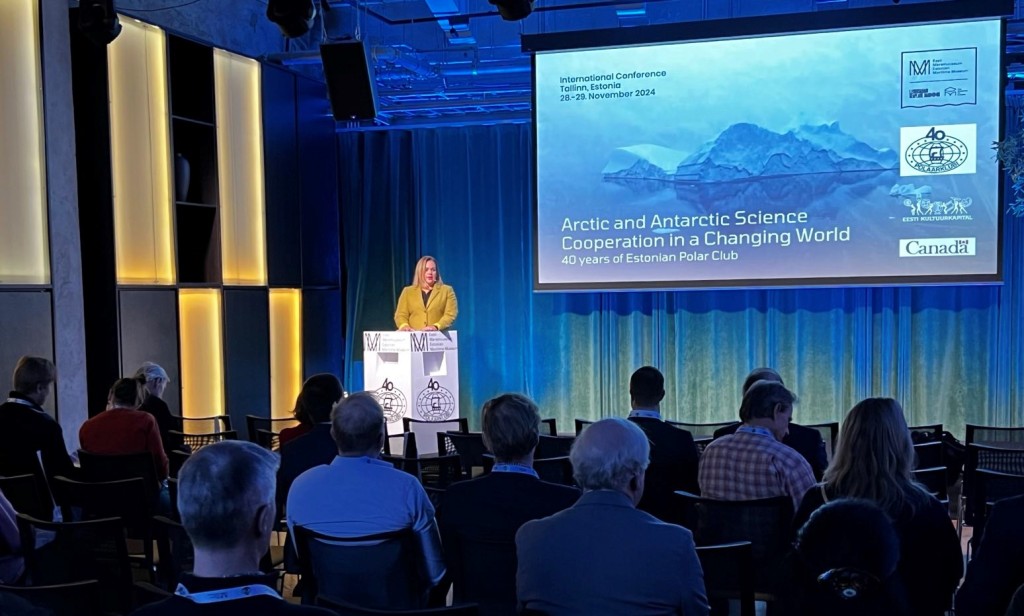
Dear distinguished guests,
Just over a year ago I held a speech at our Academy of Sciences, where I mentioned that Estonia is one of the northernmost non-Arctic countries. This closeness can be felt: as climate change in the Arctic is progressing, its effects also manifest in our region. Changes in the coastal erosion and ice regime of the Baltic Sea, in the composition and circulation of the atmosphere, as well as in the biodiversity of our region are closely intertwined with changes in the Arctic.
Understanding those challenges and responding to them requires cooperation. Therefore, Estonia considers itself a dedicated partner and friend for Arctic countries. Our focus has been and remains on our contribution to the sustainable development of the Arctic. Our polar research traditions have a very long history and our scientists have long-standing commitments to polar research on several topics. The field of expertise is really diverse. From Arctic atmosphere and biosphere research and ice-core studies to social sciences and research collaboration with indigenous peoples. On the technical side, we also have notable capabilities in developing underwater autonomous vehicles to study Arctic marine environments. More widely, Estonia is known as one of the most integrated, forward-looking and digitalized countries in the world. Our data-oriented approach could come handy for solving the challenges facing the Arctic. All this gives our scientists a stake in spearheading those global efforts.
As a party to the Antarctic Treaty, Estonia is committed to preserving and strengthening international norms in the Antarctic region. Estonia has research history on the continent. Contemporary Estonian scientists have cooperated with other countries for research purposes in Antarctica, sometimes using their facilities. Estonia is committed to the protection of the rules-based international order everywhere, including in Antarctica, which is affected by global tensions.
Ladies and gentlemen,
I would like to thank the Estonian Polar Club, whose fortieth anniversary we have gathered to celebrate today. Your mission is to promote knowledge about the polar regions and your dedication to doing this through human connections is admirable. It is also essential in raising the next generation, who values the scientific approach to care for and learn about our shared planet. Forty years is also a significant number. Forty years ago, it was a completely different time in Estonia and the possibilities for civic organization were far more restricted than they are today. The fact that you managed to establish yourselves already back then and continue until today manifests the grassroots-level interest and care for polar issues in our society.
Meanwhile, not only has our society become free, but our attitude towards environmental protection has also changed. Estonia has considerably stepped up its climate action in recent years. This paradigm shift, demands a fundamental transformation of society, economy, and mind-set. We place climate policy at the center, by implementing the green transition action plan. We are focusing on capacity building and sharing of our experience in the digital and green transition in international cooperation. We hope to build new partnerships with other ambitious countries and see this paradigm shift resonate more widely in the world.
In the Arctic context, I am happy to announce that since the beginning of this year the Estonian Ministry of Foreign Affairs has our very own Arctic Action Plan. Developments in the Arctic directly impact us and we aim to contribute actively. A comprehensive action plan consolidates our aims and efforts.
The Baltic Sea remains the focus of our regional cooperation. Our overreaching aim is to contribute to the sustainable development of the Arctic and the understanding of the connections between environmental changes in the Baltic Sea and the Arctic region. We aim to achieve this through scientific cooperation and also in the field of regional cooperation, environmental protection and climate diplomacy.
We want to maintain scientific and civil society links with Arctic indigenous peoples and strengthen those connections in areas where we have expertise or capabilities to contribute.
In terms of security, we want the Arctic to remain a conflict- and tension-free region. To achieve this, it is important for the Allies to ensure situational awareness of security developments in the Arctic and the ability to deal with threats from all directions, including the Arctic.
Ladies and gentlemen,
The level of freedom in a society can be judged based on how it engages its most vulnerable members. In the wider world we might assess the level of freedom based on how smaller nations are treated.
With its unjustified and brutal war against Ukraine, Russia has alienated itself from the principles of peaceful international cooperation. Today, Russia has an overwhelming military presence in the Arctic and its interest to enhance its military capabilities there has grown. For this reason alone, we need to pay attention and stay vigilant.
We are also witnessing utter disregard towards the environment by aggressor states. The current Russian regime also does not seem to prioritize the protection of Arctic environment. We rather see Russia overexploiting Arctic territories to advance its economic interests at the expense of the environment and indigenous peoples. We see Russia staking everything on fossil fuels even as it is consumed by ever larger forest fires and the large-scale melting of permafrost.
Not surprisingly, in the Arctic, the consequences of Russia’s aggression have hit the hardest scientists, activists and indigenous peoples, whose work depends on cross-border access. The NGO-s that so need international cooperation are being harassed and threatened with the label of foreign agent or worse. Environmental activists are frequently sent to jail.
But there is another global actor – China, whose activities must also be monitored.
While Chinese footprint both in the Arctic and Antarctic is so far mainly scientific, commercial and economic, there are potential risks in their actions. We are also monitoring the increasing Sino-Russian cooperation in the Russian Arctic. For example, non-ice class vessels are increasingly used by the two in polar regions, creating additional environmental risks. Although thus far China has played by the rules, they have articulated their much wider ambitions a long time ago.
We believe that it is in everyone´s interest to maintain the Arctic as a low-tension area where international law is upheld and peaceful scientific interests prevail. We believe, that the current geopolitical context calls for a consolidation of like-minded countries, with renewed focus on preserving a habitable planet. In case of Arctic, the relevant governance structures, such as the Arctic Council, are there, as necessary and relevant as ever. The question is, how to make most out of them in a situation where one Arctic state does not play by the rules nor the spirit of such cooperation and poses a conventional as well as a hybrid threat. From our perspective, the Arctic Council should continue its policy of openness to new partners, new observers, based on merit.
Ladies and gentlemen,
We firmly believe that all indigenous communities should have a strong voice in discussing the future of the Arctic and we wish to represent that voice. For us this region is not about economic gain or geopolitics, it is in our heart and I guess it is safe to say that the Arctic is in our DNA. Finno-Ugric roots unite Estonia with the indigenous peoples of the Siberian Arctic.
For decades, Estonian ethnographers, linguists and folklorists have studied the indigenous people of the Russian Arctic. The University of Tartu has also been pioneering in the field of genetic studies and personal medicine. The largest genetic database of Siberian peoples is stored in Estonia. Estonia has been continuously supporting the indigenous peoples of the world through the UN structures and we are a strong supporter of the World Congress of the Finno-Ugric Peoples. Since 1999, we also have a state program to support the languages and cultures of the Finno-Ugric and Samoyed indigenous peoples.
Honored Guests,
I believe that this conference shows how closely connected not only the Baltic Sea and the Arctic are, but both Polar regions with each other and with the changes on the whole planet. I really hope that from the MFA’s side, we can be good cooperation partners for the Estonian Polar Club, to spread this knowledge and build those crucial connections that will help us understand and respond to the climate crisis.
Thank you!

