
The fateful year of 1944
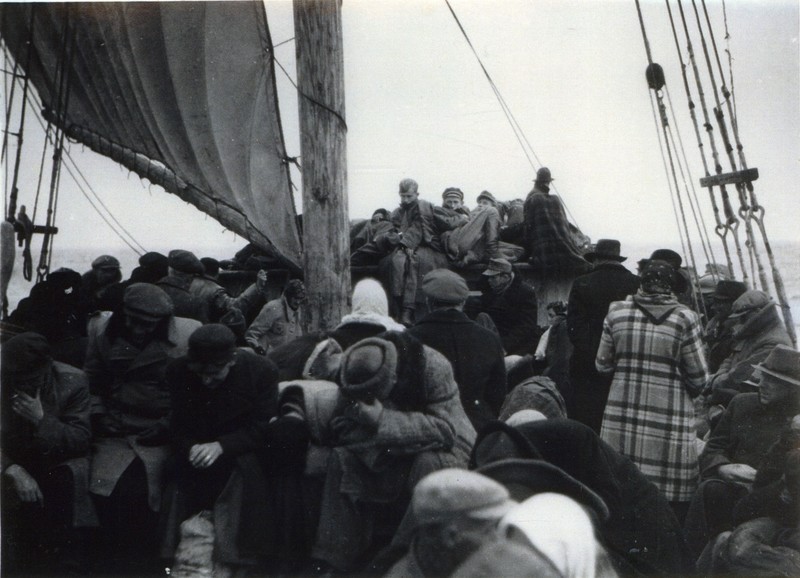
In the late summer and autumn of 1944, 70 000-80 000 people fled Estonia during a pivotal time in the Second World War to escape the advancing Red Army; a total of 300 000 people left from the Baltic States. This year marks the 80th anniversary of these events. Many people who left never saw their homeland again. The Estonians who reached the West carried a solid faith in the endurance of the independent Estonian state. In exile, Estonians developed a unique world that included both a political struggle for the restoration of Estonia’s freedom as well as a rich Estonian-speaking cultural life.
WHY AND HOW DID PEOPLE ESCAPE AND WHAT HAPPENED TO ESTONIA?
- The flight was driven by a great fear of the invasion of the Red Army because the terror of the first Soviet occupation (from June 1940 to July 1941) was still fresh on people’s minds. During this time, thousands of people were repressed in Estonia, many political leaders, members of the cultural and economic elite were arrested, some were executed and the disappearance and imprisonment of people was organised on a mass scale. Estonian men were forcefully mobilised into the Red Army. People had painful memories of the deportation organised by the Soviet authorities on 14 June 1941, with more than 10 000 people forcefully sent to Siberia from Estonia.
- However, soon the Soviet occupation was replaced with the German occupation, which lasted from the autumn of 1941 until the autumn of 1944. During this time, the active Jewish community of Estonia was destroyed, and Estonians who resisted the occupying powers were imprisoned or killed.
- In 1943, as the frontline began to inch closer to Estonia, Coastal Swedes began to flee with the help of Swedish authorities, and a great number of Estonians left with them. The stream of refugees that was relatively small took on mass proportions in the summer and autumn of 1944. Nearly 70 000-80 000 people left Estonia as a result of evacuations/fleeing to Germany as well as Finland and Sweden. The refugees included people from all social and age groups.
- The journey had become extremely hazardous due to hostilities and the stormy sea. Small boats were usually meant for coastal fishing only, not covering extended distances while overcrowded. According to estimates, 6-9% of refugees lost their lives on this journey. Today it is impossible to say how many boats never reached their destination and were lost at sea. Among larger vessels transporting refugees to Germany, two perished due to hostilities: the hospital ship Moero that left Tallinn on 21 September, and the naval training ship Nordstern that left Kuressaare on 3 October.
- Taking advantage of the political situation when the German forces were retreating and the Soviet troops had not yet entered Estonia, Jüri Uluots, the Prime Minister and acting President of the Republic of Estonia, appointed the government of Otto Tief on 18 September. It was a desperate attempt to restore the Republic of Estonia in the vacuum between two occupying powers. The importance of this government is that it served as the basis for the legal continuity of the Republic of Estonia. The fate of the members of Otto Tief’s government was brutal – they were executed or sent to forced labour camps in Siberia; some managed to escape.
- On 22 September, the Red Army invaded Tallinn. Bloody battles were waged on the island of Saaremaa, where the Red Army only managed to take control of the Sõrve Peninsula on 24 November 1944.
- At the Yalta and Potsdam conferences, the Soviet Union achieved its goal that the Allies did not contest the Baltic States remaining in the Soviet Union. However, they continued their policy of non-recognition. For Estonia, the political ramifications of the Second World War only came to an end with the restoration of Estonia’s independence in 1991 and the withdrawal of Russian troops in 1994.
ACTIVITIES OF ESTONIAN COMMUNITIES IN EXILE
- In total, more than 40 000 Estonians arrived in Germany and German-occupied territories; with another 27 000 Estonians arriving in Sweden. Estonian refugees mostly converged in camps for displaced people in the US and British occupation zones in Germany. The camps with the largest Estonian communities were located in Geislingen, Augsburg and Lübeck, with several thousand Estonian refugees living in each one at peak capacity. These camps were closed as late as the early 1950s.
- People left their homeland temporarily, for a few months or a few years at most. Once it became clear that there was no going back, people settled or relocated to new countries across the world. The largest Estonian communities formed in Sweden, the United States of America, Canada, the United Kingdom and Australia. Some refugees, alongside the people who had served in the German army – around 21 500 people in total – repatriated to the Estonian SSR. The Soviet Union had launched a powerful propaganda machine to this end.
- In larger host countries, Estonians formed various national communities that were engaged in preserving Estonian culture and fighting for the restoration of Estonia’s statehood. Many organisations continue to operate to this day. Many creatives continued their work in exile, including poet Marie Under, writer Karl Ristikivi, composer Eduard Tubin, artist Karin Luts and many others.
RETHINKING AND REMEMBERING THE FLIGHT OF 1944
The autumn of 1944 was a tragic moment in Estonian history, when the inhuman policies of dictators forced tens of thousands of people to flee for their lives. This brought enormous suffering to many and halted the normal development of Estonian life and culture for decades. Ukrainians are currently subjected to the same dark experience, having to leave their homes in Ukraine because of Russia’s military aggression.
The Estonians who fled to the West had a firm belief that the independent Estonia would endure: in the free world, our compatriots carried on the struggle of our partisans by political means, aiming to restore our state by cooperating with diplomats who had remained in the West and the Estonian government in exile. Many descendants of these refugees came to Estonia as soon as it was possible again and they have made an enormous contribution to restoring the state with their expertise and contact networks. The contribution of Estonians abroad to Estonia’s independence is remarkable.
To this day, there is no definitive overview of the number of people who left Estonia during the Second World War, of their origins and later life. In 2022, the Estonian Institute of Historical Memory began compiling a dedicated database, recording the lives of previous generations, which will serve as the basis for research and a silent memorial. The patron of this project is Estonian President Alar Karis and the database currently contains 65 000 names.
By remembering the flight of Estonians to the West during the Second World War, we are honouring the countries, communities and individuals who welcomed and helped Estonians at the time.
The flight of 1944 has been commemorated in Estonian communities abroad and at home, and this year is no different. More information about the events is available at the Global Estonian portal.


