
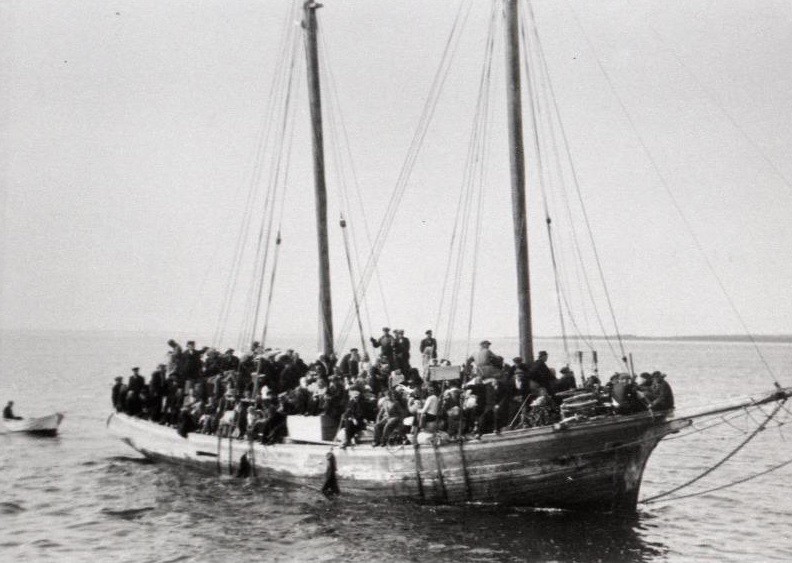
The refugees became known as boat refugees since many of them used small boats to cross the Baltic Sea to Sweden and Finland. Many of those who left never saw their homeland again. In their adopted countries, Estonians formed various organisations of expatriate Estonians that focused on preserving Estonian culture and fighting for independence in cooperation with Estonian diplomats who had remained in the West. Estonia never surrendered and resistance persisted in different forms until the independence of the Republic of Estonia was restored in 1991.
In 1943, after the German forces sustained several losses on the Eastern Front, the course of the Second World War took a turn that set off first alarm bells and a state-organised fleeing began in Estonia. The first ones to leave were the Coastal Swedes, with permission from the German authorities and assistance from Sweden, and with them, a great number of Estonians left, using various means to escape. The relatively limited escape and evacuation turned into a mass exodus in the summer and autumn of 1944. In total, around 75 000-80 000 people left Estonia (both as a result of evacuation/fleeing to Germany as well as escaping to Finland and Sweden). The refugees included people from all social and age groups.
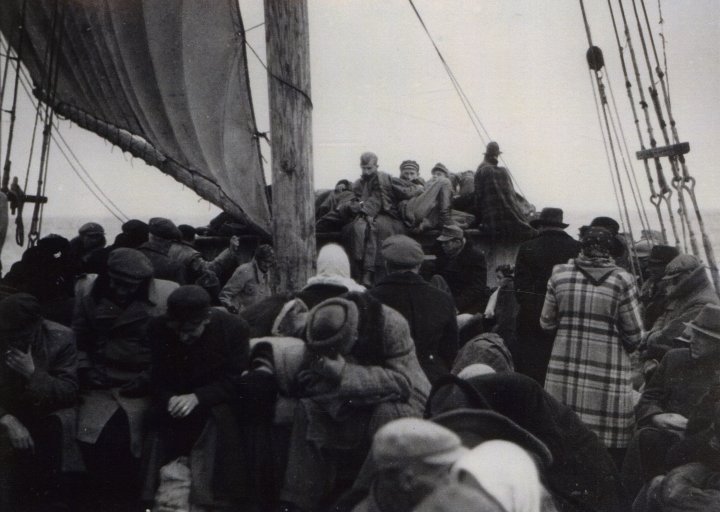
The journey had become extremely hazardous due to hostilities. Small boats were usually meant for coastal fishing only, not covering extended distances while overcrowded. According to estimates, 6-9% of refugees lost their lives on this journey. Today it is impossible to say how many boats never reached their destination and were lost at sea. Among larger vessels transporting refugees to Germany, two perished due to hostilities: the hospital ship Moero that left Tallinn on 21 September, and the naval training ship Nordstern that left Kuressaare on 3 October.
What were the reasons for leaving and what happened to Estonia?
The main reason for escaping was a great fear of the advance of the Red Army, as the terror of the first Soviet occupation (from June 1940 to July 1941) was still fresh on everyone’s mind. The first Soviet occupation saw repressions, arrests of public officials, disappearances and imprisonment, and nearly 33 000 Estonian men were mobilised into the Red Army. Estonians had also lived through mass deportations organised by the Soviet authorities on 14 June 1941 when more than 10 000 people were deported to Siberia from Estonia.
The Soviet occupation was soon replaced by the German occupation that lasted from the autumn of 1941 to the autumn of 1944. On 22 September, the Red Army seized Tallinn. Bloody battles were also fought in Saaremaa, and the Sõrve Peninsula only fell to the Red Army on 24 November 1944.
At the Yalta and Potsdam conferences, the Soviet Union achieved its goals and the Allies did not contest the Baltic States remaining in the Soviet Union. However, the policy of non-recognition continued regardless. For Estonia, the political consequences of the Second World War only ended with the restoration of independence in 1991 and the withdrawal of Russian troops in 1994.
Should you stay or go? If you choose to go, where would you go and for how long? How easy is it to leave your loved ones and homeland behind? What would become of Estonia? These questions weighed heavy on the hearts and minds of thousands of Estonians in the late summer and early autumn of 1944 when the war raged on.
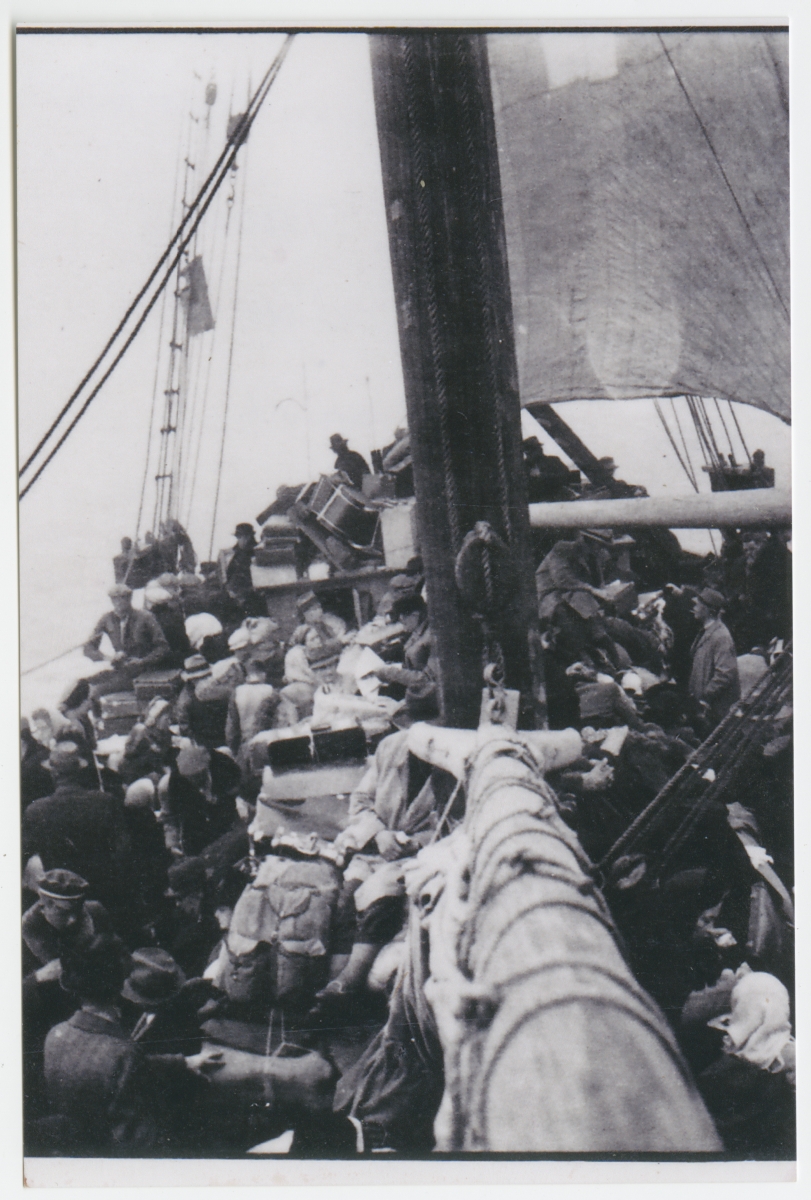
More than 40 000 Estonians reached Germany and German-occupied territories, and 27 000 Estonians arrived in Sweden. Estonian refugees usually converged in displaced persons camps in the U.S. and British occupation zones in Germany. The camps with the largest Estonian population were located in Geislingen, Augsburg and Lübeck, with each housing several thousand Estonian refugees at peak capacity. These camps were only closed in the early 1950s.
People were convinced they were leaving temporarily, for a few months or years at the most. When it became obvious over time that there was no going back, people settled or went on to other countries across the world. The largest Estonian communities formed in Sweden, the United States, Canada, the United Kingdom and Australia. Some refugees, a total of 21 500 people with those who had served in the German army, were repatriated to the Estonian SSR. The Soviet Union had set up a powerful propaganda machine for that purpose.
In these countries, Estonians formed various organisations of expatriate Estonians that focused on preserving Estonian culture and fighting for the restoration of Estonia’s independence. Many of these organisations are still active today. People like the poet Marie Under, the writer Karl Ristikivi, the composer Eduard Tubin, the artist Karin Luts and many others continued working in exile.
In remembrance of the mass exodus of Estonians to the West during the Second World War, we honour the states, communities and individuals who welcomed and helped Estonians and their families.


