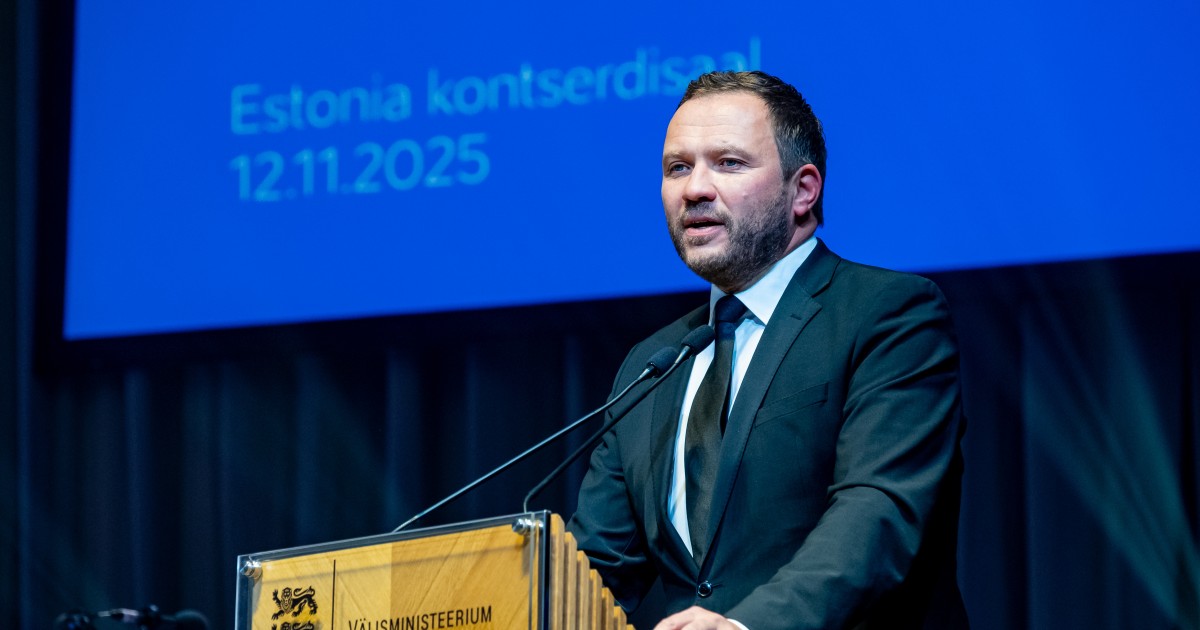
108 years ago, the Estonian foreign service was born at a time when the future of both our country and the world seemed uncertain. Today, too, we are living in a world where attempts are made to change borders and decide the fates of countries by force.
History has taught us a very important lesson: independence is not a benevolent gift from major powers. It is a right, and defending it is our shared and constant responsibility.
President Lennart Meri has once said, “History does not hold additional rehearsals.”
This reminds us that we must have the courage to make the right decisions at the right time because we cannot choose the world in which we live, but we can choose the way we act in that world.
Dear listeners,
This has been the year of Europe’s growing maturity. A year in which Europe has come to understand its strength and responsibilities more clearly than before.
I have said repeatedly that, unfortunately, the wake-up call for Europe did not come in 2007, when Putin clearly outlined his policy of aggression in his speech in Munich. Instead, it was President Trump whose message was clear: we can no longer take US responsibility for Europe’s security for granted, and there is a clear expectation that Europe will take charge.
A strong and confident Europe is the precondition for the continuation of a functioning transatlantic bond.
Europe has increased defence spending and reinforced its global position through free trade agreements. However, at the same time, we are seeing division within societies and deepening domestic conflicts. We cannot put European security on pause.
Dear listeners,
NATO is and remains the cornerstone of our collective defence. Europe must assume a more decisive responsibility for our security.
The aim of our deterrence is to rule out another miscalculation by Putin. On 24 February 2022, he underestimated the Ukraine’s resolve to defend itself and the unity of democracies.
It is our task to make sure that such a miscalculation is never made against NATO.
Both the increase in defence spending and the NATO regional defence plans agreed in Vilnius serve this purpose. Our task is to defence Allied territory from the very outset, prevent enemy forces from entering our territory and be prepared to take the fight to the aggressor’s own territory.
Putin must know that we have both the military capabilities and political will to implement these plans.
Dear colleagues,
Russia’s war of aggression does not decide the fate of Ukraine alone. It determines the kind of Europe in which we will live for decades to come.
For us, the answer is clear.
It is not the job of the West to help Russia find an off-ramp from the aggression it launched itself.
Europe cannot be a neutral mediator. We are not standing between the two sides.
We are standing with Ukraine in both war and peace.
The failure of Russia’s aggression is the precondition for Europe’s lasting security. Aggression must not be justified or rewarded.
War is always dangerous. However, history has taught us that a peace based on deals between major powers can be just as dangerous and pave the way for new wars.
It is obvious that we all want peace. No one wants peace more than the Ukrainians.
But peace cannot restore the spheres of influence of the Cold War era, which is the true goal of Putin’s policy of aggression.
Honoured guests,
Ukrainian President Volodymyr Zelenskyy recently said, “We do not want a new Yalta. We do not want Russia to cut us up on its own.”
It is a warning of historic significance. European security cannot be born of deals where major powers divide the future of other countries among themselves.
We have already lived through that history. We will not accept it a second time.
We will not allow ourselves to be silenced, because if we do not stand up for our interests, no one will.
The idea that, in order to achieve peace in Ukraine, it is necessary to make deals with Putin about Europe’s security architecture is an existential threat to us.
NATO and Europe are not led from Moscow.
The condition for peace cannot be the weakening of NATO’s deterrence or the withdrawal of Allied forces from Russia’s borders under the guise of arms control, stability or increased predictability.
I would like to remind you that Estonia shares a border with Russia and that our strategic depth is only about 200 kilometres.
Dear listeners,
One of the most important weapons Russia has is fear. We are seeing clear attempts to divide us, sow doubt, organise terror and sabotage attacks, and weaken our support for Ukraine.
Putin’s goal is to make us restrict our own choices. To refrain from acting even before he has had to achieve anything himself.
Fear cannot become Russia’s veto over Europe’s decisions. Europe’s greatest threat is not a lack of strength but hesitation to use it.
While being clear about what we will not allow Russia to do, we must be equally clear about our vision of how to achieve a just and lasting peace.
A working truce is the first step. Then peace negotiations between Ukraine and Russia. Then reliable security guarantees that will prevent a new act of aggression. This must be followed by the reconstruction of Ukraine and its political, military and economic integration into Europe.
However, today we can see no credible sign that Russia is ready to move towards peace. In the first nine months of 2026 alone, the number of civilian casualties in Ukraine increased by 59%. Yesterday, 8 November, Russia attacked Ukraine with 164 drones and three missiles, leaving more than 600,000 consumers without electricity – all while peace negotiations are being discussed.
A working truce must be the first proof of Russia’s willingness to pursue peace. As long as there is none, we must increase our support for Ukraine and ramp up pressure on Russia.
Dear guests,
Ukraine is not alone in all this.
As early as January, the Ukraine Recovery Conference will be held in Tallinn. It is our most substantial foreign policy endeavour in the coming months.
We are bringing together Ukraine’s supporters, international organisations, financial institutions and companies.
We are focusing on Ukraine’s energy security, investment, economic recovery and integration into the European Union.
The task of Estonia’s foreign service over the coming months is to devote all its efforts to this undertaking. We must make full use of existing formats for cooperation among Allies and step up our efforts within them to ensure that world leaders come to Tallinn with concrete decisions and practical assistance for Ukraine.
At this very moment, in one of the darkest hours of the war, Ukraine needs action that will provide certainty about the future.
Dear listeners,
The enlargement of the European Union is equally important.
Enlargement is not an act of charity towards candidate countries. It is a strategic objective: to unite Europe into a force capable of ensuring lasting peace and remaining competitive in the global economy.
We must not allow grey zones or so-called neutral buffer states to emerge between the European Union and NATO on the one hand and Russia on the other, with Moscow able to decide their fate.
Such grey zones do not ensure peace. Experience has shown that they create fertile ground for further aggression.
Ladies and gentlemen,
Europe needs countries that stay the course, take the initiative and are able to bring others along.
This is where cooperation between the Nordic and Baltic countries has a particular role to play.
Estonia’s chairmanship of the NB8 cooperation format has shown how our region can speak with a common voice and carry increasing weight in European decision-making.
Our influence is built on strong partnerships, shared values and a willingness to act together.
I am particularly pleased to welcome three colleagues and good friends here with us today: Lithuania’s Foreign Minister Kęstutis Budrys, Sweden’s Foreign Minister Maria Malmer Stenergard and Armenia’s Foreign Minister Ararat Mirzoyan.
Lithuania and Sweden are our close friends and Allies, with whom we share an understanding of security, values and Europe’s future.
Armenia is an important partner for us, and strengthening its ties with Europe creates new opportunities.
Thank you very much, dear foreign ministers, for joining us today!
Dear friends,
Estonia’s influence depends not only on what we say. It also depends on where we are present and the relationships we are able to build.
That is why we have expanded Estonia’s diplomatic presence around the world. This year, we have opened embassies in Armenia and Moldova. The opening of embassies in Azerbaijan, Kenya and Brazil is coming up in the near future.
The opening of five new embassies will bring the number of Estonia’s foreign missions to 50.
This means that Estonia’s interests will be better represented, our voice will carry further and we will have more opportunities to stand up for the interests of our people, businesses and country.
Economic diplomacy is equally important. Estonia’s economy can grow only if our exports and international opportunities grow.
We have developed our economic diplomacy services and business portal to help Estonian companies access foreign markets.
Today, I would like to give special thanks to the entrepreneurs who have the courage to explore new markets, invest in Estonian industry and innovation, and have a vision for the future of our economy.
A strong Estonia needs enterprising people and an economy that is open to the world.
Dear colleagues,
The 108-year history of Estonia’s foreign service is a story of Estonia’s independence and security, but also of its future.
Our strength has always lain in our ability to stand united in defending Estonia’s most important interests. We are once again approaching an election. Differences of opinion and political competition are a natural part of democracy. However, Estonia’s security and core foreign policy interests must take precedence over day-to-day political disagreements and personal vanity.
We must preserve this unity in the future too.
Throughout its history, Estonia’s foreign service has been the bearer of this continuity, standing up for Estonia’s interests regardless of political changes.
But standing up for Estonia’s interests also means standing up for every Estonian, especially when times are difficult.
Dear friends,
The Ukrainian writer Serhiy Zhadan, who decided to go to the front, has said: “The Ukrainian army is made up of ordinary citizens, not superheroes or aliens.”
He was speaking about people who have families, jobs, fears and dreams. People who have taken responsibility for their country.
This also tells us something important.
Freedom does not endure solely thanks to constitutions, treaties and international institutions. It endures thanks to people who are willing to take responsibility for defending it.
This has been the task of Estonia’s foreign service for 108 years. And it will remain our task in the future.
Thank you all for your dedication and your work for Estonia.
I would also like to extend my special thanks to our loved ones, whose understanding and support make it possible for us to carry out this demanding work.
Congratulations on the 108th anniversary of Estonia’s foreign service!
Long live Estonia!
Thank you.