
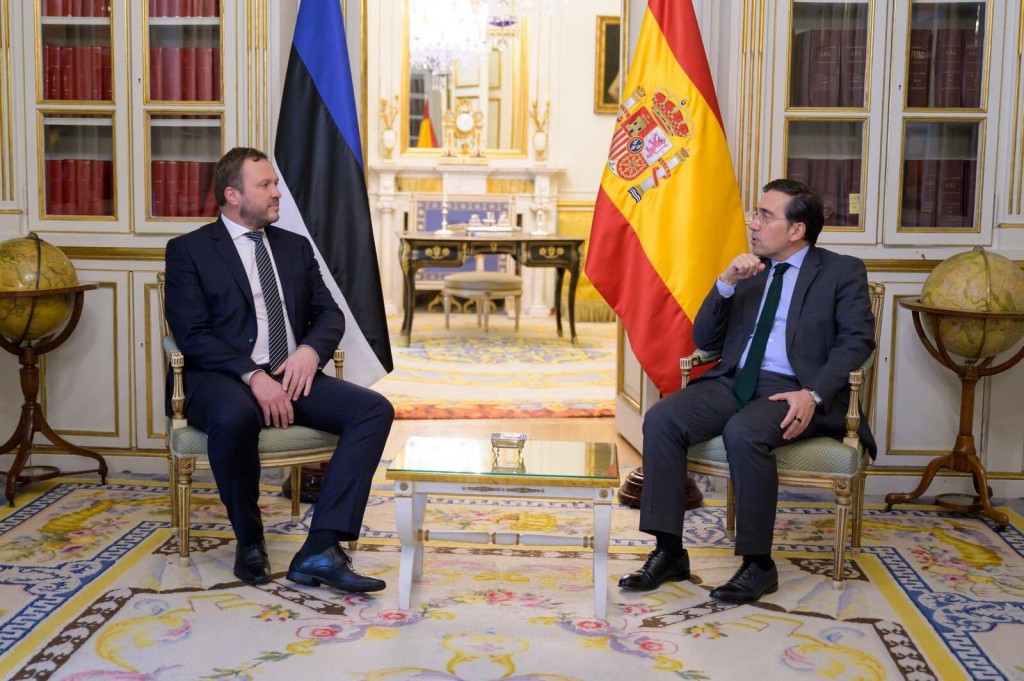
“Estonia and Spain act as partners in the European Union and as Allies in NATO to strengthen deterrence and defence, ensure effective transatlantic relations, and promote Europe’s competitiveness and unity. Estonia highly values Spain’s contribution to the security of NATO’s eastern flank, including its participation in NATO’s Baltic Air Policing mission in Estonia,” Tsahkna said, adding that to face current and future threats, Allies must increase defence spending and rapidly strengthen NATO’s European pillar.
“Russia is and will remain the most serious and long-term threat to Europe as a whole, targeting us by organising hybrid attacks, spreading instability in Africa, and fuelling migratory pressure,” Tsahkna said. “Acting together to counter Russia’s actions strengthens security in both the Baltic and Mediterranean regions.”
Speaking about Russia’s aggression against Ukraine, Tsahkna said that although Estonia and Spain are located at opposite ends of Europe, it is vital for the security of both countries that Russia does not succeed in its attempts to change borders by force.
“For this reason, we must continue along the path of supporting Ukraine and increasing pressure on Russia. We are working to adopt a strong 20th EU sanctions package in the coming weeks, including sanctions against Russia’s energy companies, its shadow fleet and those enabling its activities, as well as a ban on maritime services for vessels exporting Russian energy carriers,” Tsahkna said.
“The state of Russia’s economy is deteriorating, and the stronger the pressure we exert through sanctions, the fewer resources Russia will have to continue the war and it will be forced to abandon its course of aggression,” the foreign minister said. “In addition to strengthening sanctions, pressure should also be increased by imposing customs duties on goods from Russia and Belarus."
“Estonia recognises Spain for its military support to Ukraine and for its participation in the IT Coalition established under the leadership of Estonia and Luxembourg to assist Ukraine, through which Ukraine’s armed forces and Ministry of Defence are supported in the fields of communications and information technology,” the foreign minister said.
The ministers also discussed deterring Russia’s shadow fleet, which, in addition to security considerations, is important for protecting critical infrastructure and the environment in both the Baltic Sea and the Mediterranean.
The foreign ministers also discussed in depth the threat posed by Russian fighters to internal security in Europe.
The ministers also discussed EU enlargement, the development of security guarantees for Ukraine, transatlantic relations, the establishment of a special tribunal, and the promotion of economic cooperation between Estonia and Spain.
Today, Foreign Minister Tsahkna also spoke at the Elcano Royal Institute and at the diplomatic school of the Spanish Ministry of Foreign Affairs, where he addressed European security.
Tomorrow, the foreign minister will meet Estonia’s honorary consuls in Spain, as well as Estonian e-residents and Estonian entrepreneurs operating in Spain.

