
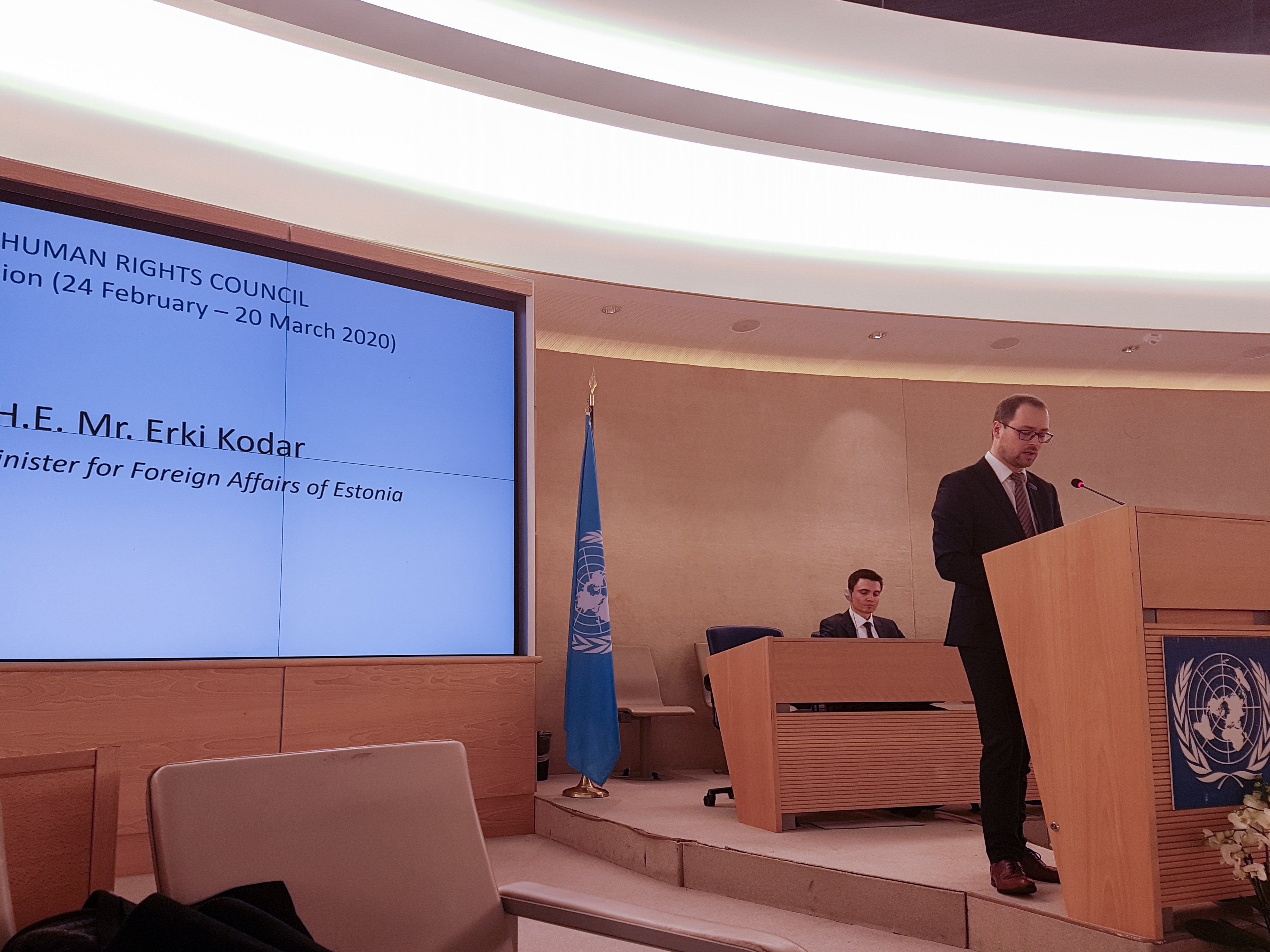
Statement by Mr Erki Kodar, Deputy Minister of Foreign Affairs of Estonia
High Level Segment of the 43rd Session of the UN Human Rights Council
Geneva, 26 February 2020
Madame President,
Excellences,
Ladies and Gentlemen,
It is a great honour for me to address you today.
Let me start by reaffirming our support to the integrity and independence of the mandate of the High Commissioner on Human Rights and her Office and to this Council`s mechanisms, including the special procedures.
The three pillars of the United Nations system - peace and security, development, and human rights - are interlinked and mutually reinforcing. Estonia will continue to support and promote a rules based international order that relies on a strong and effective UN system.
We welcome the Call for Action on Human Rights presented here by the Secretary General on Monday.
As to the promotion and protection of human rights, we should recognize and commend the equally important and indispensable role of the human rights defenders, who day after day put their own rights at risk defending others. Women defenders, often working in life-threatening circumstances are particularly exposed to sexual and gender-based violence. There is mounting evidence that systematic and often State-led strategies are used to silence defenders. Reprisals for cooperating with the UN are also numerous and on the rise. We need to support the human rights defenders in their crucial work and to move on from documenting reprisals to preventing and responding to these, if needed publicly, by ensuring full accountability. Last week, Estonia co-sponsored an Arria formula meeting of the Security Council on this crucial issue.
In recent years, there has also been a rise in the scale and number of attacks against the safety of journalists and media workers. We are concerned about the lack of accountability and impunity of perpetrators that has to be stopped.
Estonia, as a member of the Freedom Online Coalition and also of the Media Freedom Coalition, established last year, would like to stress the importance of freedom of expression online and offline. Estonia has been vocal in advocating for the free and secure Internet. We are glad to note that in many cases protesters and human rights defenders around the world are leveraging the internet to organize online and to stand up for their rights. Nevertheless, we also see highly worrying trends on governments shutting down and restricting access to the Internet in all or some parts of countries in order to - among others most probably - to silence the dissenting voices. By doing this, freedom of expression and assembly are restricted and the work of human rights defenders, bloggers and journalists limited and hampered. We are concerned that many states are asserting excessive control over the Internet under the pretense of ensuring national security while disregarding international human rights law and the principles of an open, free, secure, interoperable and reliable Internet.
New avenues are invented to erode the universal principles of human rights and often security aspects are used for this purpose. We would like to stress that the security-related laws, policies and practices need to be developed in a manner consistent with international human rights law.
Madame President,
This year is highly important concerning gender equality and women's full enjoyment of all human rights. We should use the 25th anniversary of Beijing Declaration and Platform for Action and the 20th anniversary of the Security Council resolution 1325 in order to make tangible progress in the field. 25 years after committing to ensuring full implementation of the human rights of women and girls as an inalienable, integral and indivisible part of all human rights and fundamental freedoms, we should easily be able to agree on practical steps forward. We should reject any attempts to undermine the agreed normative framework, including as to the sexual and reproductive health and rights.
Last year's celebrations of the 30th Anniversary of the Convention on the Rights of the Child revealed that although progress has been made, still a long way remains ahead. It is more than timely to renew the commitments to end violations against children and to ensure accountability. Let me mention, that Estonia co-sponsored the presentation of the report of the Independent International Commission of Inquiry on the Syrian Arab Republic in New York last week. The report provides a deeply distressing overview of the serious and widespread violations of the rights of children by all parties to the conflict during the last 9 years. It is most unfortunate that the Security Council has not been able to act on this, especially in the light of the ongoing humanitarian crisis in Idlib.
As to Estonia's human rights priorities, let me also mention that Estonia remains a strong supporter of the human rights of indigenous peoples, including their participation in meetings of UN bodies on issues affecting them. We welcome the decision on the International Decade of Indigenous Languages, to draw attention to the critical loss of, and urgent need to preserve and promote indigenous languages.
Madame President,
On the sixth anniversary of the Russian military aggression against Ukraine, we draw once again your attention to grave violations of international law including extensive violations of human rights. Respect for sovereignty, territorial integrity and the prohibition of the use of force are fundamental principles of international law. Estonia will, among others, organize an Arria format briefing in New York in March in order to provide an opportunity to hear first-hand accounts and expert assessments on the human rights situation in the Autonomous Republic of Crimea and the city of Sevastopol, Ukraine.
As a member of the UN Security Council, Estonia emphasizes the International law as the cornerstone of peace and security and rules based international order. We consider conflict prevention as essential part of Security Council`s activities and human rights violations as an early warning of potential conflict. We would like to stress that as to the prevention efforts, it is highly important for all countries to cooperate and give access to Special Procedure mandate holders. We also support a better information exchange between the Security Council on the one hand and Human Rights Council, Special Procedures and the Office of the High Commissioner for Human Rights on the other. It is crucial that the Security Council take into account and consider the valuable work of the High Commissioner and the Human Rights Council in frames of the Security Council deliberations.
I wish you a successful session.
Thank you!
Statement by Mr Erki Kodar, Deputy Minister of Foreign Affairs of Estonia, at the Human Rights Council
26.02.2020 | 13:25
Gallery
News

