
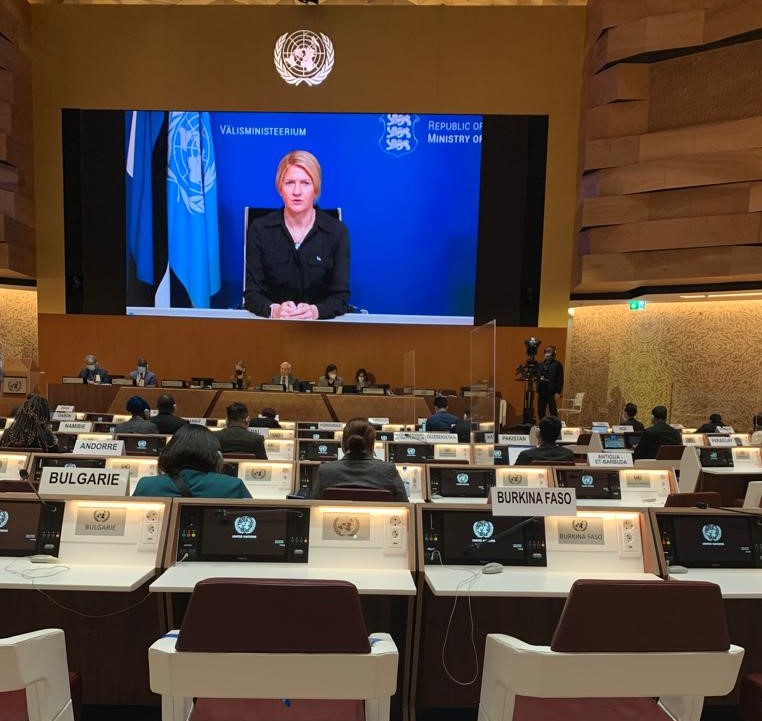
Mister President,
Excellencies,
Ladies and Gentlemen,
This spring’s Human Rights Council is being overshadowed by a large-scale war, started by Russia in the centre of Europe – in Ukraine. This has led to a widespread humanitarian catastrophe already in 5 days. I was in Kyiv, when the bombing started. I saw and felt the tragedy of despaired people on my road out of the country – I was then returning home, they were leaving theirs. International community must stand up and act so that they have their homes back.
Now – in 2022 – we are all witnessing a major aggression against them, against the core principles of international law, and against peace. Russia alone is responsible for what has happened and must be held fully accountable for its unprovoked, aggressive and illegal actions against Ukraine’s sovereignty and territorial integrity and a crime against the people of Ukraine.
Let me be clear – we are witnessing an aggression like which Europe has not seen since the end of the Second World War. Soon there are millions of victims of war, Russia must grant humanitarian access to people in need of food and medicines. We must act immediately to impose massive and severe costs on Russia. The international community must send a strong and united political message explicitly condemning Russia’s illegal actions against peaceful Ukrainian population. Actions that look like as a precursor of the genocide.
We have to stand with Ukraine and the people of Ukraine. We must lend Ukraine as much political and practical support as possible. We must be vocal in demanding the protection of human rights and international humanitarian law by the Russian Federation. Therefore, we welcome the decision to hold an urgent debate on Ukraine and call for the adoption of a strongest possible resolution.
Russia, the aggressor that launched a war against another sovereign state and is causing the death and suffering of innocent people, is today a member of the Human Rights Council. Let me recall that the members of the Council are obliged to uphold the highest standards in the promotion and protection of human rights. The only way to retain the credibility of the Human Rights Council, is to suspend the membership of Russia of the Council.
Mr President,
The fact that Russia has chosen the path of aggression and has rejected diplomacy is not surprising in retrospect. This issue and the potential threats have been repeatedly discussed in the meetings and sessions at the Human Rights Council.
Preparations by Russia for the launch of a large-scale invasion against Ukraine have been going on for many months now. Indeed, as allies and partners from the democracies made significant diplomatic efforts to avert conflict, Russia continued to amass troops on Ukraine’s border.
The link between the human rights situation and security is direct. The more authoritarian a state is, the more aggressive it is. Serious human rights violations often indicate potential armed conflict and thereby function as a warning mechanism.
Over the last two decades, we have seen a steady decline in human rights in Russia and Belarus. Democratic institutions and associations are being repressed, civil liberties and human rights are suppressed. These are the very bitter fruits we have today.
Mr President,
At the current 49th session of the Human Rights Council, we will discuss a resolution on human rights defenders and will consider the reports of the Special Rapporteur. The importance of the role of individuals and civil society institutions that promote and protect human rights and fundamental freedoms cannot be overestimated. Their actions are very much needed and deserve sincere gratitude. It is our duty to support and protect these people and institutions.
Growing authoritarianism in many countries has led to a situation where civil society institutions are being instrumentalised. Human rights defenders discover that they have been branded as foreign agents, have suddenly become dissidents in their own country, and face real imprisonment.
They also face regular threats, attacks, reprisals and acts of intimidation by the authorities. Women human rights defenders, who are often working in life-threatening circumstances, are particularly exposed to sexual and gender-based violence. There is mounting evidence that systematic and state-led strategies are used to silence human rights defenders. All these incidents of violence need to be documented and we demand that those responsible are brought to justice. The international community must do everything to prevent such acts of violence.
Mr President,
I also want to express my concern for the human rights group Memorial International, whose first honorary chairman was Nobel Peace Prize winner Andrei Sakharov, and which has recently been closed by Russia’s Supreme Court.
Please allow me to pay tribute to all journalists who, like human rights defenders, stand for human rights and human dignity and often sacrifice their lives to tell the truth.
A few weeks ago, the Global Conference for Media Freedom was held in Tallinn, the capital of Estonia. The motto used by the conference comes from the Universal Declaration of Human Rights:
“The freedom to seek, receive and impart information and ideas through any media /—/ is crucial to enabling the exercise of all other human rights.”
Next year, we will celebrate the 75th anniversary of this key UN document, and it is as relevant as ever.
Thank you for your attention!

