
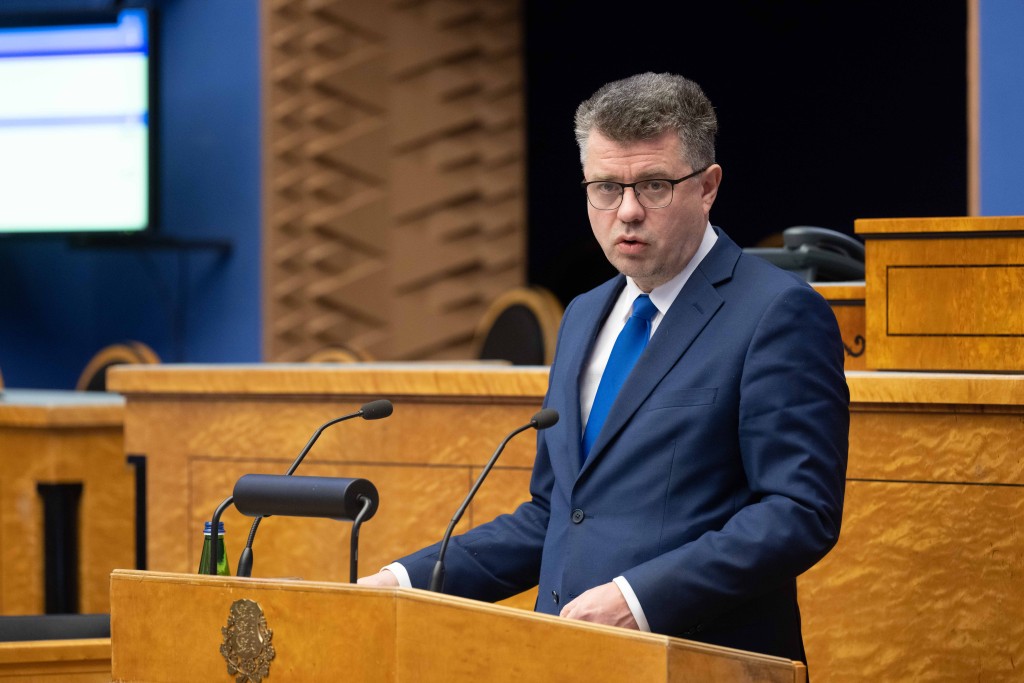
Reinsalu said Estonia had provided Ukraine with extensive weapons assistance – ranging from Javelins to armoured vehicles. “We have provided large calibre and modern weapons. Providing weapons is central and Estonia has been very visible in this regard. Estonia’s military aid to Ukraine has reached 1% of Estonia’s GDP. As early as last November, I called on NATO Allies to follow Estonia’s example and I will continue to do so. We must support Ukraine with heavy weaponry. This includes fighter aircraft,” the minister said.
He called on like-minded countries to agree on the issue of frozen assets. “Europe is currently looking for legal options for using frozen Russian assets to help Ukraine and rebuild it. Estonia is creating its own financial instrument that allows it to use these assets for the benefit of Ukraine.”
Reinsalu also underlined that Russia’s political and military leadership that has launched a war of aggression against Ukraine must be brought to justice, including Putin himself. “We are supporting Ukraine’s efforts to establish a trans-regional international special tribunal. The first step is opening an office of a temporary prosecutor in The Hague, which would be in charge of collecting and preserving evidence of crimes of aggression,” he said.
Since Russia started its full-scale war against Ukraine, Estonia and the European Union have continued to impose sanctions against Russia. “The next sanctions package must further damage Russia’s economy. We must also review the crude oil price cap in March to further reduce Russia’s revenue,” the minister said. Reinsalu added that we must jointly restrict the entry of Russian citizens to the EU and stop their ownership of assets in the EU.
Reinsalu said that Ukraine should start accession talks with the European Union this year, and just as Ukraine will become a member of the European Union, it must also join NATO.
The foreign minister also stressed that Finland and Sweden joining the Alliance will significantly reinforce the defence of NATO territory. “This step is crucial for not just the defence of the Baltic Sea region but the security of all of Europe and the cohesion of NATO,” the minister said.
Foreign Minister Urmas Reinsalu annual speech on Estonia’s foreign policy at the Riigikogu
Honoured members of the Riigikogu, the diplomatic corps, foreign policy enthusiasts,
I must begin with extending my condolences to the people of Türkiye and Syria, who experienced a devastating earthquake last week. Tens of thousands have been killed and injured, and the images we are seeing are touching, sad and tragic. We, Estonians, stand with these people in their grief and sorrow. We will try to assist as many people as we can to help life return to normal and reduce human suffering.
It is almost a year since Russia launched a full-scale war of aggression against Ukraine. This war has shocked us, it has been abhorrent. The terror and genocide Russia is using against Ukraine has not brought any glory, honour or power to Russia. The systematic bombing of kindergartens, theatres and residential areas is utterly wrong.
Ukraine has resisted the aggression bravely and courageously. They have won battles on the battlefield and in international politics. The war has brought us – that is, Estonia and the international community in general – closer together. We have already done a great deal to support Ukraine’s struggle. However, it is extremely important to recognise that we must and can do more to ensure Ukraine’s victory. Until the aggressor has been repelled back across pre-war borders. Until the perpetrators of crimes have been brought to justice. Until Russia has paid a just price for the destruction and suffering it has unleashed.
The founding principles of the international order, our future, are at stake. Russia’s aggression against Ukraine is not merely a question of Ukraine’s security. The rules-based international order and the foundation of Europe’s security are under attack.
Honoured members of the Riigikogu, dear audience,
Our aim is Ukraine’s victory. To achieve this goal, Estonia’s actions are based on three broader policies.
Firstly, raising the cost of the aggression. Russia must have no will and options to continue waging war. The cost of continuing the aggression must be higher than the cost of ending it. Russia must clearly understand that there will be no return to normal if it continues on its current track.
Sanctions are a substantial element of raising the cost of the aggression and they are already showing results. Many countries and regional organisations have imposed them. Estonia has also efficiently contributed to the nine sanction packages of the European Union against Russia’s aggression. They have considerably weakened Russia’s economy and therefore, its military power. The European Union has included 1382 Russian individuals and 167 organisations in total on the sanctions list. We have removed the largest banks of Russia from the global SWIFT system, we have frozen assets and imposed travel bans. We made a great contribution to developing price caps on gas and oil. However, this is not enough. We are working to make sure that the price caps are reviewed and lowered. It is also not acceptable that Russian propaganda continues to find ways of spreading its false messages in Europe.
Europe is currently looking for legal options for using frozen Russian assets to help Ukraine and rebuild it. The European Union and the G7 states have frozen about €300 billion worth of assets connected to the Russian Central Bank. There are also around €19 billion worth of assets of Russian oligarchs in European Union countries. Estonia is creating its own financial instrument that allows it to use these assets for the benefit of Ukraine.
Raising the cost of the aggression also means that Russia can have no place in international life. As it commits mass violations of international law and norms, Russia must be isolated. We have called for Russia losing its seat and role in international organisations. Estonia led the way with like-minded countries in achieving the expulsion of Russia from the Council of Europe and the suspension of the aggressor’s membership in the UN Human Rights Council. It is extremely regrettable that the world must once again face Russia’s application for membership in the Human Rights Council for the 2024-2026 period. We can only have one goal – Russia must not find its way back there. There is no justification for continuing to engage with the aggressor as usual on the international arena. No organisation is purely technical now.
Today it is unthinkable that the aggressor belongs in the governing body of an organisation or sub-organisation, no matter how specific. We will continue to work towards Russia no longer being a member of Interpol – sensitive information cannot be shared with war criminals. It is unacceptable that a country with no regard for the lives and health of the people of Ukraine continues to be the location for the regional centre of the World Health Organisation.
Russia is shamelessly trying to utilize sport. Sport is not something taking place in a vacuum. This is why Russian functionaries have no place in international sports organisations, and unfortunately, Russian athletes have no place in international competitions. As early as last autumn, I sent a letter to the International Olympic Committee, stressing that the restrictions on the participation of Russian and Belarusian athletes in international competitions must remain in force until the war against Ukraine has ended.
Ladies and gentlemen,
The second policy contributing directly and effectively to victory is offering comprehensive assistance to Ukraine. Ukraine must have enough strength and oxygen to defeat the aggressor. We stand with Ukraine to make sure it does not become exhausted and lose faith and hope. Estonia has been quick and vocal when it comes to supporting Ukraine. Efficient, as well, I daresay. We began sending heavy weaponry to Ukraine even before the start of the aggression. We convinced others that Ukraine must be given European Union candidate country status right here and now. We were at the forefront of setting a price cap on Russian oil. Last August, President Zelenskyy asked Estonia to restrict the access of Russian citizens to the European Union. Estonia, alongside the Baltic States, Poland and Finland, showed an initiative and imposed a regime that restricted access to the European Union for citizens of the aggressor state.
There are many more examples of how we have systematically shaped international politics in support of Ukraine with our quick and purposeful actions. It is Estonia’s role to show an example. We have no taboos when it comes to helping Ukraine.
As Ukraine makes progress with reforms, its link to the European Union must become increasingly solid. We would like see Ukraine launching accession negotiations with the European Union this year. We will provide comprehensive advice and support to Ukraine to make sure it meets the criteria for launching accession talks. In addition, Estonia is also pushing for Ukraine joining the internal market of the European Union, which could happen even before the final accession is completed. We would like to perpetuate the treatment of Ukraine as a candidate country by EU institutions and member states in all European Union processes.
Just as Ukraine will become a member of the European Union, it must also join the North Atlantic Treaty Organization. The Alliance reiterated this policy, adopted years ago, in black and white last year. Now it is crucial for Ukraine to make tangible progress towards NATO membership. NATO will hold a summit in Vilnius this summer. Ukraine’s NATO membership is an essential part of the future European and international security architecture. A part of the future lasting peace in Europe. Estonia’s diplomacy is making efforts for Ukraine to have a clearly defined path to NATO, to have specific milestones and to have Ukraine meet them.
Estonia has provided extensive weapons assistance to Ukraine – ranging from Javelins to armoured vehicles. We have provided large calibre and modern weapons. We have cooperated with the Netherlands and Norway, and Germany to send one and two field hospitals respectively to Ukraine – an excellent example of cooperation between Allies. Providing weapons is central. Estonia has been very visible in this regard. To put it bluntly, we have led the way. Most importantly – the assistance provided by us and others is badly needed at the front. Here I would like to recognise the Ministry of Defence and the Defence Forces who have led Estonia’s strong and effective efforts to deliver weapons to Ukraine. Estonia’s military aid to Ukraine has reached 1% of our GDP. As early as last November, I called on NATO Allies to follow Estonia’s example and I will continue to do so. We must support Ukraine with heavy weaponry. This includes fighter aircraft.
From the perspective of the European Union, the European Peace Facility has been the principal tool for providing military assistance to Ukraine. The decisions to support Ukraine with its instruments speak of the ability of member states to act in a fast, flexible and united way. However, we cannot stop here, leave it at that. The instruments of the European Peace Facility must be increased considerably.
The most important precondition for peace is Ukraine’s victory on the battlefield. Yet we must rebuild Ukraine now, even before the guns fall silent. Estonia is proving that this is possible even during the war. For it to happen as smoothly and efficiently as possible, the international community needs to join forces. The reconstruction assistance must grow. Coordination between various parties must become smoother. The reconstruction of Ukraine is closely related to European Union integration – reconstruction projects must contribute to accession and be informed by that spirit. Ukraine’s recovery from the war must go hand in hand with rooting out corruption and reinforcing state institutions.
The Ministry of Foreign Affairs considers cooperation with the public, private and third sector in reconstruction efforts in Ukraine one of its central policies in the coming years. Estonia’s reconstruction efforts are concentrated on the Zhytomyr Oblast. Our projects there include the construction of a prefab kindergarten by Estonian entrepreneurs together with the local people. We are also about to start rebuilding the Malyn bridge. There have already been two Zhytomyr reconstruction forums, most recently in Tallinn before Christmas.
Estonian companies must also have a chance to take part in reconstruction projects financed by the European Union and other states. We encourage companies from Estonia and other countries to invest in Ukraine. It is important for the European Union to create a mechanism for protecting private sector investments already during the war.
Ukraine is facing a humanitarian crisis on a daily basis. 17.7 million people need urgent winterisation assistance. There are 7 million displaced people in Ukraine – more than the total population of the Baltic States. This is why we must continue to provide humanitarian aid, both countries bilaterally as well as the European Union, the UN and many others. The volume of the European Union’s humanitarian aid must remain on at least the same level this year. It would be even better if this volume increased.
Estonia as a society stands behind Ukraine. Around 60 000 refugees from Ukraine have found homes, jobs, schools and kindergartens in Estonia. This is unprecedented. We are proud and grateful to witness voluntary initiatives springing up from the bottoms of people’s hearts to support Ukraine. I would like to thank individuals who are tirelessly putting together aid packages and helping refugees who have fled the war. A big thank you also goes to companies who have supported Ukraine very efficiently.
Honoured members of Riigikogu,
Estonia’s third policy concerns the adequate and fair judgement of the acts of the aggressor. Crimes must not go unpunished. We are defined by how we respond to these crimes. Our goal as a society must be to bring perpetrators to justice. If we do not aspire to do so because the legal processes may seem too complicated and time-consuming, it would mean giving up on a world based on rules. Our goal is the opposite.
Ukraine’s victory also entails the triumph of fairness and justice. The political and military leadership of Russia that has launched a war of aggression against Ukraine must be brought to justice. However, if there is no legal mechanism for doing so, if the scope of existing courts falls short, a new tribunal must be established for judging Russia’s crimes. The prosecutor of Ukraine and the prosecutor of the International Criminal Court are currently working hard on investigating war crimes and collecting evidence. Unfortunately, the International Criminal Court has no mandate to investigate the crime of aggression and the UN Security Council is paralysed because the aggressor itself is a member. This is why another solution should be found quickly.
For Estonia, the answer to preventing impunity is clear. We are supporting Ukraine’s efforts to establish a trans-regional international special tribunal. The first step is opening an office of a temporary prosecutor in The Hague, which would be in charge of collecting and preserving evidence of crimes of aggression.
To summarise, honoured members of Riigikogu, Estonia is spearheading comprehensive assistance to Ukraine and can break taboos if necessary. We must not be afraid of the consequences of allocating more aid; instead, we must fear what happens when assistance is not provided due to hesitation. The Estonian foreign service and the entire Estonian society is making an effort to contribute to Ukraine’s victory. We will continue on this path, with a purpose and with commitment.
Ladies and gentlemen,
Every war comes to an end. And it ends in peace. This is also true of the war in Ukraine. A peace that will end Russia’s murderous aggression will determine the security of Europe, probably the world in general. The nature of the peace we will have is an existential issue for Estonia. We must be watchful because not every so-called dove taking flight from some corner of the world may herald true peace. Let us always remember how Chamberlain, on his return from Munich, announced that peace for our time had arrived. There were pitfalls of peace then and they still exist now. The wish to buy oneself stability by feeding the aggressor with the freedom of other countries brings nothing but the expansion of war. To paraphrase Churchill: if you have to choose between war and shame and you choose shame, you will eventually get war too.
It is the task of Estonia’s foreign policy to have an active say in what the post-war peace will be like. Here I would like to present our six main postulates.
First, this peace must reinforce an international order centred on the principles of territorial integrity and sovereignty, an international order where there is no room for using force to redraw national borders and where differences are resolved by peaceful means.
Second, aggression as an instrument of international relations must be completely discredited. It must be clear to national leaders harbouring ideas of aggression that the cost of aggression is always higher than the expected profit, and that it will always end in defeat.
Third, spheres of influence must be thrown into the dustbin of history. The idea that some countries have a privileged interest over others must have no place in international relations. Every country must have the right and opportunity to choose its security arrangements and allies; everyone must understand and respect this. Any suggestions of the opposite would bring back the politics of spheres of influence and we cannot accept that.
Fourth, there must be an end to the grey areas in European security. They simply do not work. Today we can clearly see that the expansion of NATO and the European Union has increased stability. Grey areas, conversely, are a breeding ground for wars and instability. This is why the doors of these organisations must remain open, credibly open, and our goal must be that all states who are willing and ready to do so are engaged in Euro-Atlantic security arrangements.
Fifth, a European Union and NATO based on common values must remain the cornerstone of security in Europe. They include countries that cherish democracy, rule of law, free market and human rights and freedoms, and are convinced that these are the main sources of development and prosperity for societies. The ability of Europe to have a say in global politics requires a strong, geopolitical European Union and a NATO that is able to defend Europe militarily.
Sixth, the precondition for relations with Russia must include the restoration of trust and ruling out an automatic reset. All the commitments that Russia is violating with its aggression have been taken on by Russia voluntarily. This way, Russia is destroying all confidence that any agreement concluded with it would last. A normalisation of relations requires the regaining of trust; it is only possible gradually and only if Russia proves with its actions that it will respect these commitments in the future. We do not want a future without Russia but we can only restore relations with a Russia whose tools are not threats and deceit, war and fear.
These six elements – the focus on territorial integrity and sovereignty; ruling out aggression; rejecting the policy of spheres of influence; the disappearance of grey areas; the endurance of a space of values based on the European Union and NATO; and linking relations with Russia to restoring trust – are the foundation for the future of Estonia and security in Europe.
Ladies and gentlemen,
How do we arrive at this kind of peace? By maintaining and reinforcing the unity of the West. The West has been united in its response to Russia’s aggression. We must preserve it. The challenges we are facing are great. However, we have a working formula for taking them on – a foreign policy that is bold, active and thorough, and offers solutions. Our work is based on the knowledge that no one notices the ones who are silent and no one listens to the ones who yell. We must work on a broad front and play a leading role if necessary.
For example, in the European Union. Estonia is consistently part of shaping the developments of the European Union and steering the future of the EU. Russia’s aggression against Ukraine has posed some pressing and somewhat new challenges for the European Union. The European Union has met them successfully and has been united, quick and flexible. We have managed to preserve the decision-making process based on consensus, which is a matter of principle for Estonia. The so-called unanimity mechanism is an essential part of the foreign policy of the European Union and makes us stronger as a union. Reaching decisions is sometimes more complicated but the decisions are reached and, having been thoroughly debated, they are all the more solid.
NATO has a central role in the military defence of our region. I can assure you that the Alliance has honed its collective defence; the transatlantic bond is resilient, substantial and effective. A shared perception of threats is the precondition for facing these threats as one and coming up with solutions that deter potential aggressors and increase the sense of security in society. Estonia has worked to boost the real and direct contribution of Allies to Estonia’s security. This is evident in the units and increasingly powerful equipment deployed to Estonia. The decisions of the Madrid summit last year about reinforcing NATO’s current posture are remarkable. Now they must be implemented.
Estonia stands for reinforcing transatlantic cooperation and unity. Last year, we celebrated the centenary of diplomatic relations between Estonia and the United States. Late last year, the United States kept its promise from NATO’s Madrid summit and deployed an infantry company and a HIMARS unit here – ca 270 US troops and 4 weapons systems in total. This step is part of a longer series of rotations that is the basis of the sustainable presence of US forces in the Baltic States. Financial security assistance from the United States to Estonia hit a record level last year. We are grateful to all Allies who have contributed to NATO’s Baltic Air Policing in the past decades and deployed their forces to Estonian territory.
Estonia, in turn, has decided to increase its contribution in the US-led international antiterrorism operation Inherent Resolve in Iraq. The number of Estonian soldiers will increase to up to 100. This step once again proves Estonia’s commitment to contributing to global peace and stability. We are showing that Estonia takes the security concerns of our Allies seriously.
Finland and Sweden joining the Alliance will also significantly reinforce the defence of NATO territory. This step is crucial for not just the defence of the Baltic Sea region but also the security of all of Europe and the cohesion of NATO. When taking this step, the security concerns of various Allies should be taken into account; however, rule of law and freedom of speech must also be ensured. In view of the upcoming Vilnius summit, Türkiye and Hungary should ratify the accession protocols of Finland and Sweden as quickly as possible.
A greater cohesion and an increasingly diverse and close cooperation in the Nordic-Baltic region is a fact and an essential part of our activities. The Nordic-Baltic region is like a core family for Estonia, with a lively common economic and innovation space that takes its strength from the principles of rule of law, freedom and equality. Last year, we compiled bilateral cooperation reports with Latvia, Sweden and Finland to explore how we would make our relations and common actions even more effective and substantial. They contain several ideas that could inform the broader Nordic-Baltic cooperation.
The continuation of the Eastern Partnership remains important for the European Union. In addition to supporting Ukraine’s membership, we must be creative and show initiative in bringing Moldova, also a candidate country, closer to the European Union. We will offer Moldova every assistance on this path. It is positive that Georgia also has an accession perspective. However, developments in the country are concerning. Georgia must clearly show in words and in deeds that it is continuing on its path of integration with the European Union. Estonia has supported the Western Balkans moving closer to the European Union and we will continue to do so.
Honoured members of the Riigikogu, dear audience,
An increasing confrontation between democracies and autocracies is becoming clearer across the world. Mutual competition can develop into a clash over global dominance, underpinned by the increasing dependence of one party on another. It is about energy dependence, technological dependence, labour dependence, economic dependence, raw material dependence, product dependence, which, when combined, can eventually lead to political dependence. It is a reality that must be addressed now, especially if we want to steer these processes instead of being swept away by them without any control. To avoid falling into the trap of dependence, the democratic West must be attentive and alert and make considered choices. We have all seen the gradual rise and increasing global confidence of China. Europe has learnt a painful lesson from its energy dependence on Russia, and indirectly so have we. The pandemic demonstrated the fragility of supply chains and previous agreements. For example, since last year, Estonia is no longer participating in the cooperation format between Central and Eastern Europe and China, the so-called 16+1. One of the reasons we decided to leave this format was the attitude and reactions to Russia’s aggression in Ukraine.
Russia’s aggression in Ukraine has been met with extensive and forceful condemnation from countries across the world. At the same time, we are seeing a list of countries who have remained impartial and have decided to wait and see. There are many things that are surprising about this list. What is important is that the number of those who condemn the aggression does not decrease and those who have hesitated so far join in the condemnation. This requires us to explain and communicate constantly, present our positions and reveal the mendaciousness of the opponent’s narrative. In short – we also need to engage with countries in other regions of the world to make them aware of the causes of the war in Europe and understand its broader context, which will shape the future and will have a direct impact on them.
In light of the changes happening in the world, we must increasingly network with trusted partners. Partners with whom we communicate based on shared interests, values and high standards, and who reject attempts by autocracies to lure other countries into becoming dependent on them. One antidote for this is connectivity – in the form of physical and digital infrastructure. Connectivity concerns energy security, green transition, economic prosperity, the resilience of supply chains, cybersecurity and development cooperation. This largely means the bloodstream of the whole world. Spearheading this development should not be just handed over to autocracies. In cooperation with other democracies, we can offer a values-based alternative. The development of sustainable connectivity based on democratic values and high standards is led by, for example the Global Gateway strategy of the European Commission, the Three Seas Initiative and the work on the UN’s Global Digital Compact. Estonia has been among the leaders in all these initiatives.
When it comes to Europe’s green transition, we must use diverse solutions – renewable energy, the digitalisation of services and production, circular economy, energy storage, carbon neutral production and consumption. As our success story so far – digitalisation – often serves the goals of the green transition, we can see the digital and green transition or the so-called twin transition becoming an essential part of Estonia’s foreign policy. There is no doubt the digital and green transition hold opportunities for Estonia’s private sector.
The global economic climate is cooling down. High inflation rates and increased energy costs are reducing the purchasing power and consumption of the global population. In addition, we must expect that protectionism will increase and economic growth will slow down. In our trade relations with partners outside the European Union, we continue to support openness and an approach based on rules. This includes the implementation of the green transition – it must also be carried out in line with rules and without discriminating the producers of different countries.
All this means that Estonian companies increasingly need business diplomacy support on foreign markets to be successful in an environment of heightened competition. The Ministry of Foreign Affairs has joined the Estonian Business and Innovation Agency and the Ministry of Economic Affairs and Communications in creating a shared business diplomacy task force to hone Estonia’s image, boost exports, bring foreign investments to Estonia and support tourism. Shared action plans make cooperation more efficient and create a clear division of tasks. Most importantly – it creates a synergy with entrepreneurs. This year, our focus will be on 20 different sectors in 19 priority countries, where the digital/IT sector, food and food technology, construction, green technology and energy sectors have the greatest potential.
Thanks to the instruments of the Recovery and Resilience Facility of the European Union, we have opened a business hub in Seoul, and a similar centre will open in Singapore in May. Our objective is to use the recovery facility to take Estonia’s business diplomacy to a new level. We will help create export opportunities for Estonian entrepreneurs in Europe, Asia, North America and Africa. In addition to the Ukraine business forum, we are organising an African business forum in Tallinn and the “Meet Estonia” forum in Abu Dhabi. We help open doors and raise awareness among entrepreneurs about the opportunities of more distant markets. Our 188 honorary consuls around the world amplify the message of Estonia’s economic environment and business opportunities.
Just as business is increasingly global, so are Estonian communities. Estonians living abroad are not separate or distant from all matters Estonian. Overall, we function as a supportive community spanning the whole globe. Estonia’s foreign policy is increasingly prioritising global Estonians. For example, we are supporting cultural events organised by Estonian societies abroad and the publication of Estonian-language media, we are funding camps of Estonian language and culture in Estonia and the traineeships of young people in Estonia. We are also contributing ideas and effort to creating a common Estonian information space to help unite Estonians into a more connected global family.
Honoured members of Riigikogu,
Finally, the situation of human rights in the world is fragile. This has been tragically demonstrated by the actions of Russia. We have observed this in Russia and in Belarus, where political power has trampled on the rights and freedoms of people. This is all the more reason for the international community to clearly condemn the actions of Russia and Belarus and other regions where human rights are under attack. This includes giving a legal assessment to what has taken place and improving the protection of rights. The UN report published last year on what is happening in Xinjiang noted the miserable situation of Uighurs and left no doubt that the central authorities have committed human rights violations. The suppression of peaceful demonstrations in Iran calls for strong condemnation. The situation in Afghanistan under Taliban’s rule – especially when it comes to women and girls – is becoming increasingly complicated. We must also not forget the Rohingyas and their plight in junta-led Myanmar.
To summarise all of the above, I would like to stress that rules must apply. Fundamental rights and freedoms must be preserved and protected. Abandoning them would also doom us.
The people of Ukraine are fighting the aggressor with incredible bravery and courage. The international community supporting Ukraine must stand united and behind Ukraine economically, politically and militarily. We are doing this so that the territory of Ukraine could be freed and its sovereignty secured. We are doing this so that we could have a peace that is a meaningful peace for both Ukraine and Estonia. For all of Europe.
Ladies and gentlemen,
Dear Estonian people at home and abroad,
We will endure!

