
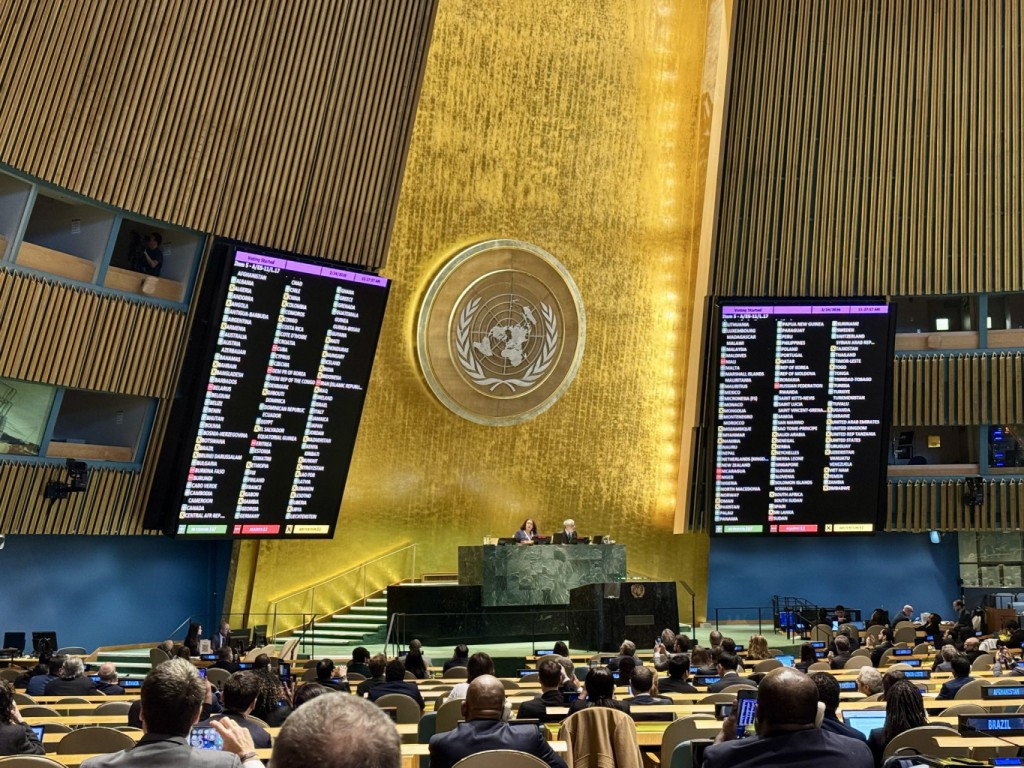
According to foreign minister Margus Tsahkna, the resolution confirms the international community’s firm commitment to the principles of the UN Charter, international law, and the protection of Ukraine’s independence and territorial integrity.
“From the very beginning, the objective of Russia – a permanent member of the UN Security Council – has been clear: to subjugate the whole of Ukraine and, in doing so, to rewrite the norms of international law,” Tsahkna said. “Through its aggression, Russia has gravely violated the fundamental principles of the UN Charter and committed serious crimes against the Ukrainian state and its civilian population – from drone attacks and the deliberate bombing of energy infrastructure to the mass deportation of children to Russia. Today’s decision shows that a large number of member states continue to condemn Russia’s aggression and demand consequences for the aggressor’s actions.”
Tsahkna stressed that the political and economic pressure exerted by the international community on Russia must be further increased. To avoid impunity, efforts to hold Russia accountable through international courts must continue. “To prosecute the crime of aggression, we must move swiftly to launch the special tribunal being established under the auspices of the Council of Europe,” the minister said. He added that Estonia considers it essential to continue supporting both Ukrainian courts and the International Criminal Court in investigating war crimes and human rights violations. “Every crime must carry a penalty,” he emphasised.
According to the foreign minister, alongside increasing pressure on Russia, the international community must stand firmly by Ukraine. “Our task is to continue providing comprehensive support to Ukraine – from military and humanitarian assistance to the delivery of critical supplies. It is also important to participate in Ukraine’s reconstruction in the longer term,” Tsahkna said.
Estonia was represented at the special session of the General Assembly and the meeting of the Security Council by Ambassador Rein Tammsaar, Estonia’s permanent representative to the UN, who stressed in Estonia’s statement that Russia’s full-scale war of aggression against Ukraine, now in its fifth year, constitutes the greatest threat to global peace and security. “Russia’s imperialist objectives with regard to Ukraine have not changed,” he said. “To end the war and the violence, all UN member states must jointly exert additional pressure on Russia. Only then can we compel the aggressor to make peace in Ukraine.”

